Bishop Mark Dyer has said that "every 500 years, the church has a rummage sale." Phyllis Tickle expands on his thesis in her book, The Great Emergence.
I have not read the book, but do find Dyer's thesis intriguing: 500 years ago the church experienced the Reformation and the beginning of the Protestant Church.
500 years before that was The Great Schism, which split the state church of the Roman Empire into Eastern (Greek) and Western (Latin) branches. Later they would be known as the Eastern Orthodox Church and the Roman Catholic Church, respectively.
500 years prior was the Council of Chalcedon and the Fall of Rome. And 500 years earlier than that, was the life, death, and resurrection of Christ.
It should be noted that this is a Judeo-Christian phenomenon, as the Fall of Jerusalem and the Babylonian captivity came 500 years before Christ, ending the 1st Temple era and ushering in the 2nd. And 500 years prior to that was the United Monarchy of Israel.
I certainly see the pattern, and notice that major events have occurred regularly for the past 2500 years, but I'm not sure I would call them all "rummage sales." So what do you think? Are we on the cusp of another radical shift in the Church?
Showing posts with label Israel. Show all posts
Friday, August 19, 2011
Thursday, January 6, 2011
Trading God
![]() |
| Nebuchadnezzar |
The Babylonian king Nebuchadnezzar (ruled 605-562), set his sights on Jerusalem, the capital city of Israel at this time, which had not fallen under Assyrian control.
Word spread quickly among the Israelites that Nebuchanezzar was on his way, and everyone wondered what to do: do we trust Yahweh to deliver us? Is it too late (Jeremiah 27.6)? Should we seek help from Egypt (2.36ff)?
The Israelites had a long history of attempting to solve their problems by looking for a more accessible "god experience." This led them to trade Yahweh, the living redeemer god, for works of their own hands:
Has a nation changed its gods, even though there are no gods? But my people have changed their glory for something that does not profit. 2.11
All nations of the ancient world had patron gods - these deities were inextricably tied to the peoples' national identity. The Moabites for instance, were known as the people of Kemosh; while the Philistines were associated with Dagon.
The unprecedented nature of Israel's rejection of Yahweh, leads Jeremiah to pen these words: Be appalled, O heavens, at this, be shocked, be utterly desolate! 2.12
The Israelites had a long history of attempting to solve their problems by looking for a more accessible "god experience." This led them to trade Yahweh, the living redeemer god, for works of their own hands:
Has a nation changed its gods, even though there are no gods? But my people have changed their glory for something that does not profit. 2.11
![]() |
| Story of Kemosh |
The unprecedented nature of Israel's rejection of Yahweh, leads Jeremiah to pen these words: Be appalled, O heavens, at this, be shocked, be utterly desolate! 2.12
In the end, Yahweh would use the coming destruction to show his people the natural progression of their destructive decision making. It was an attempt to get them to trust fully in him.
This story should get us thinking about where we might be trading God for things that do not profit, and if we are, begs us to turn from paths of destruction, to paths of life.
Friday, December 3, 2010
8 Nights & 8 Lights
Hanukkah has started. Matisyahu, the Hasidic Jew Reggae artist, has a pop video out about the celebration. It's quite catchy but a very goofy video:
Hanukkah commemorates the re-dedication of the Second Temple in Jerusalem after it was defiled by Antiochus IV (Grape guy in video) in 167 BC.
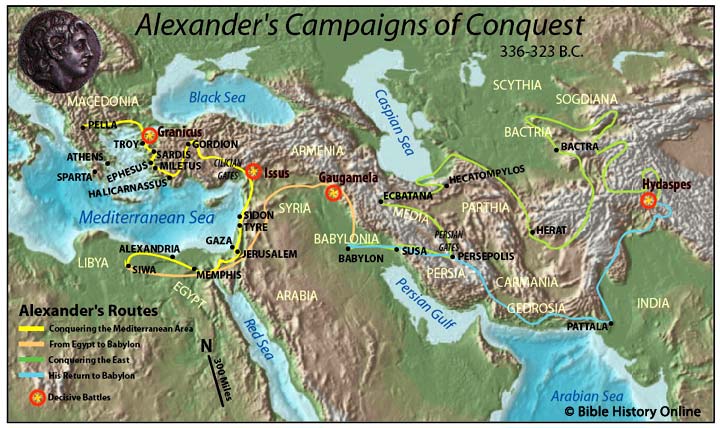
After the destruction of Jerusalem in 586 BC, Israel ceased to control the promised land, but experienced relative peace and prosperity under her new landlords: first with Alexander the Great (332-323) and then under the Ptolemies (333-198).
As Greek philosophy and language were mixing with the Semitic cultures, a process known as Hellenism, Judaism struggled to figure out if the two cultures could co-exist. The issue was mainly divided among the upper classes who embraced Hellenism and the middle and lower classes who resisted.
All of this would come to a head when the Seleucid ruler Antiohcus IV, who inherited Alexander's empire in Mesopotamia and Syria, took control of Judea and began to force Jewish assimilation. He saw the distinct identity of the Jews as a potential problem and so he plundered the Temple and outlawed religious practices.
His plan backfired on him and lead to the first Jewish war of independence, a story told in the wonderful book of 1 Maccabees. When the Jews recaptured the Temple and were in the process of rededicating it, they only had enough oil to fuel the Eternal Flame (cf. Leviticus 6.13), a candle representing the presence of Yahweh among his people, for one day.
But miraculously the oil lasted 8 days, just enough time for new oil to be pressed and consecrated. The Jews ended up gaining their independence and ruled Judea autonomously until 63, when the Romans took over.
Hanukkah is a wonderful holiday, rich with meaning and intrinsically tied to the Christian faith. It commemorates a definitive moment of God's saving activity in the world and one all Christians should be aware of.
![]() |
| A Menorah, in D.C. The middle light, called the shamash, is used to light the others. |
Hanukkah is a wonderful holiday, rich with meaning and intrinsically tied to the Christian faith. It commemorates a definitive moment of God's saving activity in the world and one all Christians should be aware of.
Wednesday, November 24, 2010
Mighty Warrior...sort of
The book of Judges records the constant cycle of: Israel's rejection of Yahweh, their subsequent bondage to foreign powers, Yahweh's deliverance using a "Judge", a human he empowers, peace for a while, and then the whole cycle starts over again!
Samson, a muscle-bound man, who desperately avoided hair cuts, was one such judge; as was Deborah, a prophetess with an aptitude for leadership. Her victory Song in Judges chapter 5, is thought to be the oldest part of the Bible because of its grammar and vocabulary.
Samson and Deborah epitomized the typical larger-than-life qualities of a judge. But there is another judge who is worthy of our attention, one that was the farthest thing from a Samson or a Deborah, and that was Gideon.
Gideon's story starts in Judges chapter 6, where the Israelites are back in trouble, this time with the Midianites and Amalekites, who are terrorizing them and eating all their food (6.3). The Israelites cry out to their god for help and Yahweh responds, telling them:
Look, I have rescued you from being enslaved to the most powerful nation in the known world, given you a place to call your own and all I have asked is that you pay attention to me and not the gods of the surrounding people! But you don't listen!
After this, Yahweh, like any good parent, begins to orchestrate deliverance. But he doesn't choose a guy with big muscles, or an amazing leader, he chooses our man Gideon, who happens to be threshing wheat in a wine press at the time God calls on him!
The irony here is simply brilliant: threshing wheat requires an open space, where the wheat would be thrown into the air and a light breeze would separate it from the chaff:
But Gideon, fearful that his enemies will come take his food, is attempting this process in a dug out wine press:
![]() |
| A wine press found in the Shephelah (lowlands) of western Israel. |
This is the image we get when Yahweh comes to Gideon saying, "Yahweh is with you, mighty warrior" (6.12). I can just picture Gideon looking around, "Are you talking to me?" And not in the De Niro Taxi Driver inflection, but in the incredibly timid, "I think you have the wrong guy."
But Yahweh didn't have the wrong guy and although Gideon was quick to point out that his "family was the weakest in the entire area, and he the least in his family" (6.15), he would go on to powerfully deliver God's people.
The story of Gideon is a great example of God meeting us where we are - hiding knee deep in our inadequacies, with all of our doubts, and using us to accomplish his ends all the same.
Go Mighty Warrior, Go!
Saturday, November 20, 2010
Moving Mountains
Jesus answered them, "Have faith in God. Truly I tell you, if you say to this mountain, 'Be taken up and thrown into the sea,' and if you do not doubt in your heart, but believe that what you say will come to pass, it will be done for you." Mark 11.22ff
This passage is a prime example of how important an understanding of the cultural and geographical context is to our understanding of the text.
Jesus often used his surroundings to help illustrate his teaching points. In this passage, he was on the road from Bethany (southeast) to Jerusalem and off to his left, 7 miles south of Jerusalem, were two mountains, the larger of which was the Herodian:
![]() | |||
| The Herodion |
The Herodion was a fortress built by King Herod (ruled 37-4 B.C.). Herod, an Idumean, whose family was forcibly converted to Judaism during the Hasmonean rule of his homeland, was appointed governor of Judea by Julius Caesar. He ruled with an iron fist, squelching all dissidents with brutal force, and was always fearful of attempts to usurp him.
Josephus, a Jewish historian, tells us:
This fortress, which is some sixty stadia distant from Jerusalem, is naturally strong and very suitable for such a structure, for reasonably nearby is a hill, raised to a (greater) height by the hand of man and rounded off in the shape of a breast. (War I, 31, 10; Antiquities XIV, 323-325)
The key detail in Josephus' account, is the fact that he used slave labor to increase the height of his fortress thus "moving a mountain" (Mt 17.20). In our passage, Jesus is saying not only will you be able to move a mountain, which had been done, but you will be able to "cast it" some 20 miles to the East into the Dead Sea.
This statement is not only religious, but also extremely political. Jesus preached on the Kingdom of God more than any other subject and his central argument in all those passages, is that God reigns. God is ruler and not Herod and not Caesar.
This message was not easy to believe because it did not look like God was in control.
This makes Jesus' message even more powerful: if you believe, and affirm with your actions, that God is in control of the world and that you are to live by the standards of his kingdom, then you will see things come to pass that were once only figments of your imagination.
As we process the powers that compete for our allegiance, the prayer of a father whose child is stricken with epilepsy becomes especially appropriate:
"I believe; help my unbelief!"
-Mark 11.24
Friday, November 19, 2010
Trouble
What do you do with a story from the Bible that troubles you? Take for example a story we find in 2 Samuel 24. The story begins:
"Again the anger of Yahweh was kindled against Israel, and he incited (Hb. suth: incite, allure, instigate) David against them, saying, "Go, count the people of Israel and Judah."
So David, the most famous of Israel's kings, convinces his general Joab to count the people. This process takes several months and when Joab finishes, he reports the total to David, who then becomes upset, confesses his sin to Yahweh, and begs for his "guilt to be removed." (v.10)
Yahweh, speaking through a prophet, gives David three options for his punishment - One: three years famine; Two: three months being pursued by his enemies; or Three: three days of disease throughout all Israel. His options could have been worse but not by much. (v.11ff)
David chooses the shortest of the three, hoping to appeal to God's mercy. The disease spreads throughout the land and "seventy-thousand of the people died." (v.15)
At this point the reader may be somewhat confused: did the text really say that Yahweh caused David to carryout the census and then accept David's confession, but in the end kill 70,000 people? Yahweh was angry with Israel and although we are not privy to know the reason, his intentions to punish were clear from the start.
The book of Chronicles adds even more intrigue to the story. Chronicles, written after the fall of Jerusalem (to the Babylonians in 586 B.C.), is the rewriting of the books of Samuel and Kings. 1 Chronicles 21 contains the updated version of our story.
It begins a little differently: "Satan (Hb. a satan, an adversary or opponent; cf. 1 Sam 29.4 and 1 Kgs 5.4 where the word satan is used as a common noun. I would argue here it is to be taken as a proper noun) stood up against Israel, and incited (Hb. suth) David to count the people of Israel." The story, other than some minor details, is almost identical from this point on.
Now the reader may be even more confused: So this text is telling us that it was Satan who caused David to carryout the census? This appears to be the case. But why? Why change the passage?
We are wise to keep in mind that Chronicles was written just after the Israelites experienced the destruction of their homeland and were carried off some 700 miles in exile to Babylon. The last thing they need is a story that illustrates God punishing people for doing what he wanted them to do. One thought is that the writer of Chronicles found Yahweh's activity in the Samuel passage troubling and decided to credit Satan with the inciting of David.
This explanation fits one of the key motifs of Scripture: God meeting his people where they are. Sometimes we can handle the formula of a book like Proverbs or Deuteronomy: do what is right and good things will happen to you. Other times we need Job: you may do everything right and bad things will still happen to you.
The Samuel story meets people who are comfortable with tension - at the time of the writing of the Samuel 24 story, Israel was at the pinnacle of her affluence and power in the ancient world. We can handle tension when things are going well.
But things were not going well for the first readers of Chronicles and so this version is safer and more appropriate for individuals whose entire world has just collapsed.
So what do we do with a story from the Bible that troubles us? We embrace the tension. We recognize that life is messy and thankfully God has been getting messy with us from the beginning (see Gen 2.4ff) and could not have gotten any messier than he did when he got into that manger.
For a detailed scholarly discussion of these passages, see the Stokes, R. JBL 128, no 1 (2009): 91-106.
Subscribe to:
Posts (Atom)