Showing posts with label Persecution. Show all posts

Monday, August 15, 2011

People Don't Like You

It's OK if people don't like you. It took me a long time to come to grips with that. I think mainly because I struggle with basing my self esteem on what others think of me.

My wife has a brilliant saying, "If everyone likes you, you are not being true to yourself."

Jesus warned his followers of this in John 15, "If the world hates you, remember it hated me before it hated you."

The Greek word for "world" here is kosmos, which literally means "something ordered" or "ordered system." We get our English word cosmetic from it, which means to "order one's face."

When Jesus uses this term he is speaking about a way of "ordering the world" that does not harmonize with God's way.

Jesus told his followers they will be hated by people who build themselves up by stepping on others; who abuse the poor and only love those inside their "circle."

If you are hated because you reject a system that marginalizes others and has no room for love, grace, and mercy - Congratulations! You are in good company.

Wednesday, January 5, 2011

A Story Worth Living

Mark has a story to tell and he wants to tell it quickly. The gospel attributed to Mark is the shortest of the four gospels and almost has a rushed sense to it. 

This is helped by Mark's use of a phrase that is often omitted in translation for more natural reading: "and immediately" (Gk. kai euthus):  

"and immediately Jesus went into the wilderness....and immediately they leave their nets and follow him....and immediately his fame spread" and on and on. 

The frantic pace of gospel leads to such an abrupt ending, that the early church felt the need to add to it, attempting to bring the work to a more satisfactory completion.  Two attempts were made at this, but the most natural ending is the original in 16.8.

The original ending leaves the reader on the edge of their seat, waiting for the next act to unfold. But the next act is not to be read, it is to be experienced. The reader is to live out the next act. 

Nero
Many feel the tempo of Mark reflects the situation of his readers, who were more than likely Roman Christians who had experienced persecution under Nero.

The themes within the gospel of conflict, and failure to side with Jesus during trials, also give credence to this theory.

Mark is a perfect gospel for the overly busy individual who doesn't have time to read the Bible. But if one were to make time, the best way to read Mark is straight through.

That is where the humor, irony, tension, and passion, come together most potently, all in an attempt to convince the reader that this story is worth telling. And even more, that this story is worth living.

Wednesday, December 1, 2010

The Unveiling Part III

Revelation, a letter meant to bring hope to persecuted Christians, uses vivid images, laden with symbolism, to convey the message that God is in control. A daunting task in a world where the Christian God seemed anything but in control. 

Many wondered: Was Jesus alive? Was God and not Caesar, really in control? Revelation shouts an emphatic "YES!" to both. The author, named John, writes: 

Grace to you and peace from him who is and who was and who is to come...and Jesus Christ, the faithful witness, the firstborn of the dead, and the ruler of the kings of the earth. 1.4-5

John challenges what Pausanias writes, "Zeus was, Zeus is, Zeus will be." 
John then tells us he was in prison "because of the word of God and the testimony of Jesus" when he heard a "voice like a trumpet" urging him to write down all he sees and pass the message on. 1.9-11

He continues:

on turning I saw one like a son of man (a human)...his eyes were like a flame of fire...and his voice was like the sound of many waters. 1.12-15

The imagery is stunning and then John illustrates the true grandeur of what he sees:

In his right hand he held seven stars, and from his mouth came a sharp, two edged sword, and his face was like the sun shining with full force! 1.16


John sees Jesus, not the Jewish peasant, but the transcendent ruler of the cosmos,  who holds the stars in his hand and whose face is as bright as the noon day sun. Who was killed, but is now alive and controls all things. 1.17-8

The sword, his only weapon, represents the word of God (Is 49.2) and illustrates the power of "testimony" - that words and the ideas behind them, are mightier than any weapon.

This image of Christ was so important to the early Christians, for it helped them remain faithful to the proclamation that Jesus is Lord.

As we read the letter of Revelation, questions about what competes for our allegiance become paramount.

Do we cave to societal pressure and engage in activities that are contrary to the fundamental tenants of our faith: Loving God, and loving people, even our enemies? Of treating all humans as the divine image bearers they are? Do we fight for justice and liberation from both societal as well as individual evils?

These are the ideas behind the claim that Jesus is Lord and Revelation asks us, "How far are you willing to go for this proclamation?"

Tuesday, November 30, 2010

The Unveiling Part II

The Greek title for Revelation is Apokalupsis, Apocalypse, which literally means "the unveiling." The idea being that the readers of Revelation would have the "veil" pulled off their eyes and be presented with the actual picture of reality.

The letter, with all of its amazing imagery, showed the reader that things were not as they seemed and although it may not look like it, God, not Caesar, was actually the one in control of history. That "Jesus Christ was the ruler of the kings of the earth" (Rev 1.5).

A Christian Dirce by Siemiradzki - a Christian woman martyred under Nero.
At the heart of Revelation is a message aimed at bolstering perseverance in the face of adversity and as I wrote yesterday, the original readers were experiencing adversity.

Here's how the text conveys that message:

Revelation 1.3 reads "Blessed is the one who reads aloud the words of the prophecy, and blessed are those who hear and keep what is written in it; for the time is near."

When a letter reached a community in the ancient world, the community would gather and listen to the letter read out loud.

So it's Brando and he's not reading, but you get the idea!
This is how the letter of Revelation was received by its original communities - a fact that dramatically affects how the book is to be understood. The first readers, the majority of which were actually "hearers", wouldn't have had the opportunity to sit and investigate every line of the letter.

Instead, the hearer-reader would have listened to the letter from start to finish and allowed the vivid imagery to overwhelm him/her. In this way the hearer-reader could not help but be immersed in the powerful message that God was in control and would one day make all things right (Rev 21.3-5).

And although the images are quite unfamiliar to the modern reader, they weren't to the original audience. Of the 404 verses in the letter of Revelation, 278 of them contain either an allusion to or a quotation from the Hebrew Scriptures.

The original hearer-readers had no problem understanding the powerfully symbolic language, nor any problem knowing what to do with it.

In this way, Revelation functions much like the modern day movie trailer:


The trailer, through its powerful images, intense music, and emotional subject matter, serves only one purpose: to convince the audience to see the movie.

Revelation's powerful images, intense scenarios, and incredible picture of hope for those who trust God, serve only one purpose as well: to infuse life into the most desperate of circumstances.

Keep this in mind the next time you crack open the letter of Revelation. Read it letting the images overwhelm you and use its message of hope and its challenge to live as if God is really in control, to guide you through your life.

For an excellent resource for your journey through the letter, see Eugene Boring's commentary that is the farthest from his namesake.

Monday, November 29, 2010

The Unveiling Part I

The letter of Revelation, written during the reign of the brutal Roman emperor Domitian (ruled AD 81-96), addressed an audience who wondered if being a Christian was worth the cost. General resentment towards Christians had started about 30 years earlier when Nero blamed them for the Great Fire of Rome.

The Great Fire of Rome, AD 64
The Roman historian Tacitus (AD 56-117) tells us:

In accordance, an arrest was first made of all who pleaded guilty; then, upon their information, an immense multitude was convicted, not as much of the crime of firing the city as of hatred against mankind. Mockery of every sort was added to their deaths. Covered with the skins of beasts, they were torn by dogs and perished, or were nailed to crosses, or were doomed to the flames and burnt, to serve as a nightly illumination, when daylight had expired. (Annals, 15.44)

The Torches of Nero by Siemiradski, 1876. Look closely as Christians are the torches.
It was unclear whether the Christians "pleaded guilty" to arson or simply to being Christian. None-the-less they were severely punished and as Tacitus notes, not so much for the crime, but for "hatred against mankind." Christians objected to many elements of Roman culture and this caused them to be viewed in this way. 

In AD 70 the temple in Jerusalem was destroyed by the Romans. This was the second destruction of the Temple, the first being in 586 BC by the Babylonians. This event forever changed the face of Judaism and its relationship to the sacrificial system.
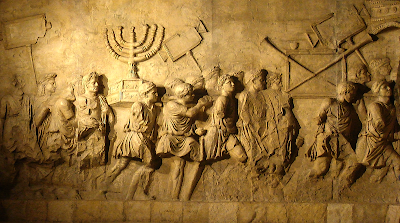
The Arch of Titus - carrying away the spoils from the Temple.
Then in AD 79 Mount Vesuvius erupted, blacking out the sky for hundreds of miles and burying Pompeii. 

Mt Vesuvius as seen from the ruins of Pompeii
Times were turbulent and to make matters worse, Domitian, who thought of himself as divine, began enforcing emperor worship. When he appeared in public he would urge the crowds to shout:

All hail to our Lord (kurios, which is the same word used for Jesus in the NT) and to his Lady!

Domitian
Domitian put police in place to enforce his veneration and those who did not comply were banished or even executed.

This is the context for Revelation. The recipients of the letter were feeling pressure to assimilate with the Roman culture, as being a Christian was beginning to cost them convenience, social status, and even their lives. 

They needed to hear that God was in control and proclaim that Kurios Christos, Christ is Lord, and not Kurios Kaisaros, Caesar is Lord, even in the face of death.

Revelation is one of the most misinterpreted texts in the Bible -  which is a shame because such interpretations miss out on how incredibly practical the letter is. 

Check back tomorrow for more on Revelation.